
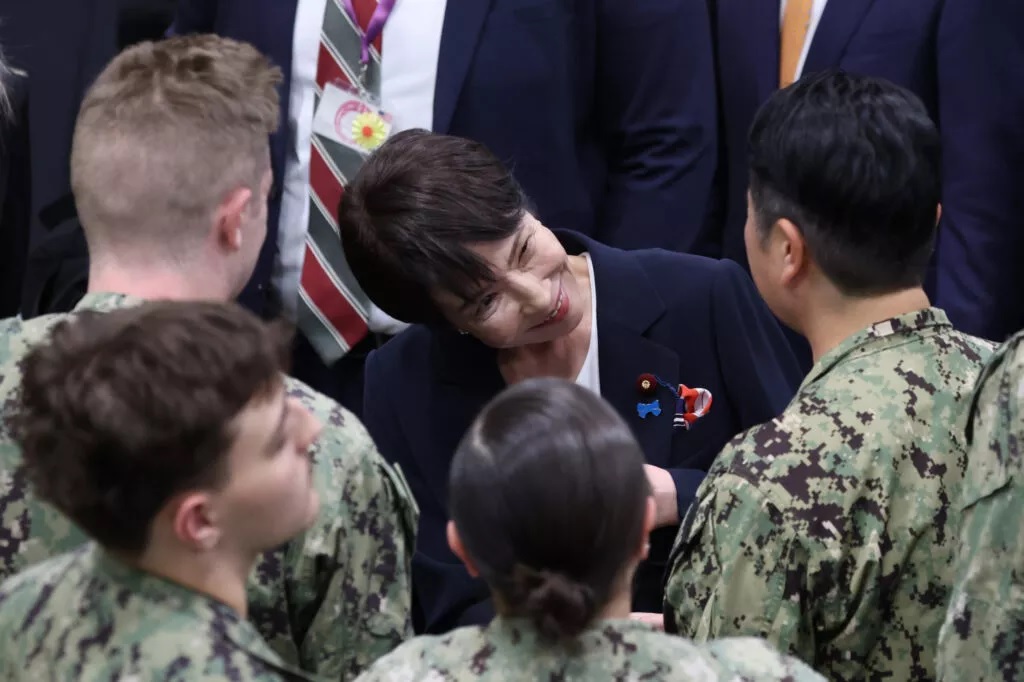
Japan is preparing to lift long-standing restrictions on lethal weapons exports, marking another step in the erosion of its post-war arms export taboo. While the reform creates new diplomatic and commercial opportunities and allows deeper security cooperation with regional partners, Japan’s defence industrial base remains small, costly and capacity-constrained. Domestic procurement demands and labour shortages mean exports will likely remain modest, limiting the policy’s practical and strategic impact on regional military balances.
Prime Minister Sanae Takaichi’s government is looking to loosen Japan’s long-standing restrictions on weapons exports, marking another step in a decades-long erosion of post-war export bans. While the policy shift opens new diplomatic and commercial opportunities, Japan’s limited defence industrial capacity means the change will remain largely symbolic.
Japan banned the export of weapons in the 1960s and 1970s, relaxing the prohibition only slightly in 1983 to permit exports to the United States. A more significant shift came in 2011, when former prime minister Yoshihiko Noda of the Democratic Party of Japan significantly relaxed the ban to allow for the co-development of weapons with US allies and exports for peacebuilding and humanitarian missions.
Further relaxation under former prime minister Shinzo Abe in 2014 permitted the more general export of non-lethal military equipment. These adjustments enabled a flurry of weapons co-development agreements with Western countries, including Japan’s participation with Italy and the United Kingdom in the Global Combat Air Program to produce a next-generation fighter jet. But restrictions on lethal weapons exports remain, especially to countries involved in armed conflict. This has, for example, prevented Japan from exporting weapons to Ukraine.
The Takaichi administration is now looking to remove most remaining restrictions on lethal weapons exports. The ruling Liberal Democratic Party’s long-time coalition partner, the anti-militarist Komeito, had opposed further loosening beyond the 2014 reforms. But after Komeito exited the coalition over Takaichi’s right-wing policies, the government reached an agreement with a new coalition partner, the Japan Innovation Party, which strongly favours lifting the restrictions.
The coalition appears ready to remove the existing framework limiting Japan’s military exports to five categories of non-lethal equipment. Exceptions already exist for weapons systems considered part of ‘international joint development and production projects’. Since 2023, these have allowed Japan to export Patriot PAC-3 air defence missiles to the United States, which had drawn down its own stocks by supplying Ukraine and Israel. Japan’s deal to supply upgraded Mogami-class frigates to Australia and its participation in the fighter jet program with Italy and the United Kingdom also fall under these exemptions.
Lifting the five-category restriction would permit exports beyond joint-development projects, allowing the transfer of weapons to countries involved in ongoing armed conflicts. It may also broaden Japan’s Official Security Assistance program (OSA), a new type of foreign aid established in 2023 to parallel the country’s long-standing Official Development Assistance (ODA). OSA has so far only been used to provide non-lethal surveillance and reconnaissance equipment to mostly South China Sea littoral states, but lethal weapons may soon be provided under the framework.
The Philippines may become the first beneficiary of the policy change. Unconfirmed reports — later denied by Japan’s Ministry of Defense — indicated that Japan and the Philippines have held informal talks about exporting Japan’s Chu-SAM air defence missile system. Accurate or not, the reports indicate the type of lethal weaponry that Japan is likely to export. The surface-to-air missile system has a limited range and is primarily a point-defence weapon. It would not, for example, be able to cover a significant part of the South China Sea.
The new export policy would provide an opportunity for Japan to reinforce security partnerships without the kind of mutual defence commitment that an alliance would entail. It may also create significant commercial opportunities for Japanese firms. But the new policy also raises questions about oversight of weapons exports and whether Japanese weapons might end up in the wrong hands, creating political, if not security, challenges for Japan.
Yet the biggest challenge is a lack of capacity. Japan’s post-war defence industrial base has essentially had only one customer, the Japan Self-Defense Forces. Consequently, the scale of this base has been limited, with high costs and low profit margins. Despite several relaxations of export restrictions and government efforts to reinforce the defence industrial base, a significant number of companies have exited the industry in recent years.
The 2022 decision to increase Japan’s defence spending by approximately 60 per cent could be seen as helping to reverse this trend, but procurement for the Japan Self-Defense Forces will absorb nearly all available production capacity in Japan’s defence industry for the foreseeable future. Japan’s ageing and shrinking labour force, and a shortage of the skilled and specialised labour needed by the defence industry, reinforce these limits.
Finally, as long as the Japan–US alliance remains intact and reasonably close, most of the spare capacity in Japan’s defence industrial base will likely be dedicated to helping the United States address shortfalls in its strained defence industrial base — as seen in Japan’s production of Patriot missiles and Washington’s requests that Japan repair US warships.
The export of lethal Japanese weapons will likely remain modest, with the partial exception of exports to the United States. Much of what Japan does export will likely be older systems retired from service in the Japan Self-Defense Forces, such as the five trainer aircraft repurposed for maritime surveillance and transferred to the Philippine military in 2017–18. The anticipated easing of restrictions in 2026 will carry more symbolic than strategic weight, with little reason to expect a meaningful impact on the regional balance of power for Japan and its partners.
Read more by Paul Midford Meiji Gakuin University
Paul Midford is Professor of International Relations at Meiji Gakuin University. He received his PhD in Political Science from Columbia University.







Be First to Comment