
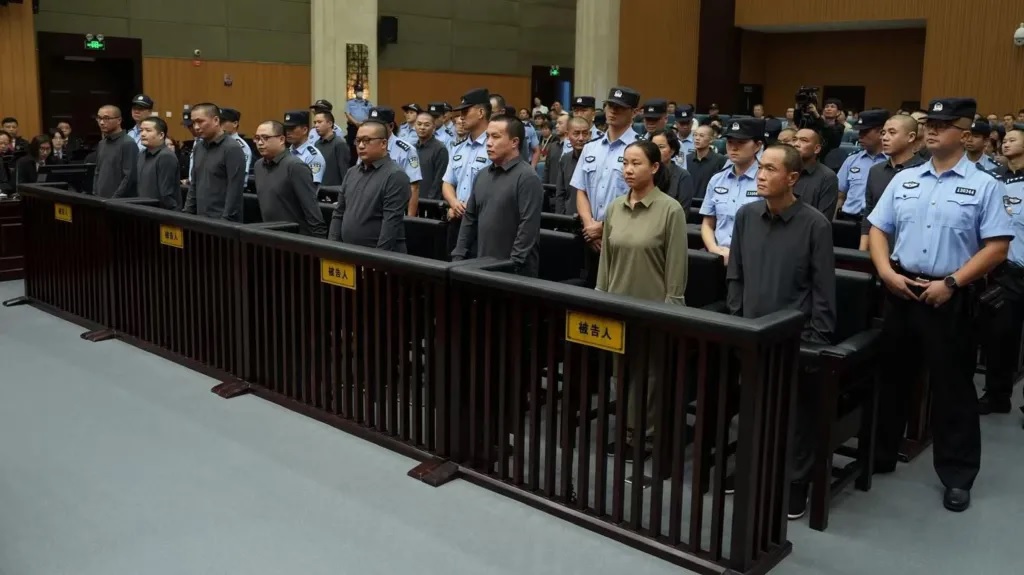
The 11 defendants of the northern Myanmar-based Ming family crime syndicate case, who was sentenced to death in September 2025, were executed, CCTV reported Thursday.
The defendants organized, led or participated in crimes of the syndicate, their acts constitute more than 10 criminal charges including intentional homicide, intentional injury, illegal detention, fraud and running casinos.
The Wenzhou Intermediate People’s Court in East China’s Zhejiang Province in September 2025 sentenced the syndicate members Ming Guoping, Ming Zhenzhen, Zhou Weichang, Wu Hongming, Wu Senlong, Fu Yubin and five others to death, along with corresponding additional penalties.
Some of the defendants appealed and the Zhejiang Higher People’s Court of rejected the appeals and maintained the first-instance verdict on November 25.
China’s Supreme People’s Court reviewed the case and confirmed that since 2015, the Ming family criminal gang, led by core family members including Ming Guoping and Ming Zhenzhen, had established multiple compounds in northern Myanmar’s Kokang region. The group recruited multiple financiers and provided armed protection to carry out telecom fraud and illegal gambling, involving more than 10 billion yuan ($1.4 billion) in illicit funds.
The criminal gang also colluded with other telecom fraud groups to deliberately kill, injure and illegally detain fraud-related personnel, resulting in the deaths of 14 Chinese citizens and injuries to several others, the Supreme People’s Court confirmed, according to CCTV News.
The top court ruled that the defendants committed extremely serious violent crimes with particularly egregious circumstances and consequences. The facts were clear, evidence sufficient, convictions accurate, sentencing appropriate and trial procedures lawful. The death sentences were therefore approved.
After receiving the criminal ruling and execution order from the Supreme People’s Court, the Wenzhou Intermediate People’s Court carried out the executions in accordance with the law. Prior to the executions, close relatives of the convicted individuals were granted to meet with them, CCTV reported.
With these executions Beijing is sending a message of deterrence to would-be scammers. But the business has now moved to Myanmar’s border with Thailand, and to Cambodia and Laos, where China has much less influence.
Hundreds of thousands of people have been trafficked to run online scams in Myanmar and elsewhere in South East Asia, according to estimates by the UN. Among them are thousands of Chinese people, and their victims who they swindle billions of dollars from are mainly Chinese too.
Frustrated by the Myanmar military’s refusal to stop the scam business, from which it was almost certainly profiting, Beijing tacitly backed an offensive by an ethnic insurgent alliance in Shan State in late 2023. The alliance captured significant territory from the military and overran Laukkaing, a key border town.
Who are the Ming family?
The eleven members of the Ming family are the first of the Myanmar scam bosses to be executed by China.
But they will not be the last. Five members of the Bai family were also sentenced to death in November, and the trials of two other groups of defendants from the Wei and the Liu families have not yet concluded.
The Ming family’s trial was held behind closed doors, although more than 160 people were allowed to attend their sentencing hearing last year, including families of victims.
The Ming mafia’s scam operations and gambling dens brought in more than 10bn yuan ($1.4bn; £1bn) between 2015 and 2023, according to China’s highest court, which rejected their appeals in November. Their crimes resulted in the deaths of 14 Chinese citizens and injuries to many others, the court said.
More than 20 others from the Ming family were given jail sentences in September ranging from five years to life. Ming Xuechang, the clan’s patriarch, killed himself in 2023 while trying to avoid detention, Myanmar’s military had said back then.
The confessions of those who were arrested were aired in state media documentaries, to emphasise Chinese authorities’ resolve to eradicate scam networks.
The Mings were among a handful of Godfather-esque families who rose to power in Laukkaing in the early 2000s. This was after the town’s then warlord was ousted in a military operation led by Min Aung Hlaing, who became the leader of Myanmar’s military government after the 2021 coup.
The head of the family, Ming Xuechang, ran one of the most infamous of Laukkaing’s scam centres, Crouching Tiger Villa.
At first gambling and prostitution were the main sources of income for these families, but they eventually started online fraud, staffed mostly by people who were kidnapped and forced to run these scams.
Within the walls of the sprawling, well-guarded compounds was a culture of violence. Beatings and torture were routine, according to testimonies collected from freed workers.








Be First to Comment